10 Mar 2013

Practical Wireless (April 2013)

G3XBM in New Zealand (Abel Tasman National Park) Feb 2009
For the second month in a row I have an article in Practical Wireless. This time it is one submitted several years ago describing my operation on 70cms FM when on holiday in New Zealand in 2009. New Zealand has an excellent internet-linked repeater network that links repeaters all across the country, so one can work from the very south of South Island all the way to the top of North Island and talk to anyone on this linked network.  I found this invaluable when on holiday.

Sadly the exchange rate is not as favourable now as in 2009, but New Zealand is a wonderful place for a once in a lifetime holiday, with very friendly and welcoming people.

If you get PW, I hope you enjoy the article.

Optimised 481THz receiver

As the weather was miserable here today, I decided to work on the K3PGP derived 481THz optical receiver this morning. I wanted to ensure it was working at maximum sensitivity with subcarrier tones around 100-1500Hz. With some adjustment of the coupling capacitors and the addition of an HF roll-off capacitor on the collector of T2, the sensitivity now appears to be excellent. My test is an AF modulated red LED on the ceiling of my building shack, in almost total darkness, with the test receiver (less any lenses) on the bench about 1.5m away. If the receiver is working credibly then the tone can be heard in the headphones when the LED is barely lit. In the case of this latest receiver I cannot even see the LED lit at all in a darkened room, yet the tone is audible in the receiver. When comparing this with my previous best optical receiver there is around (guess) 6dB more sensitivity. This design uses "blog standard" components: nothing selected for low noise, and not an IC in sight. I am now waiting for some decent weather - and no snow please - to test this on my NLOS test path.

9 Mar 2013

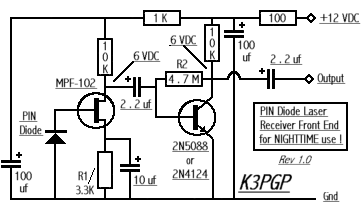
K3PGP receiver for 481THz

One of the simplest, yet highly sensitive, receivers for optical communications is one designed by John K3PGP. The G8CYW design in Practical Wireless in the March and April 2013 editions is based on this. This works really well in darkness, but is easily overloaded in any light. Many circuits are optimised for speech communications but this one works really well with digital modulation at very low frequencies where the detector sensitivity is highest.
http://k3pgp.org/Construction/Frontend/preamp.gif
Today I've been building a version and I am in the process of optimising it for subcarrier frequencies below 500Hz. I have added an extra transistor gain stage after the basic K3PGP design but want to see if lower noise FETs and transistors make a worthwhile improvement. When satisfied that it is working optimally I shall be trying this at the RX end of my over-the-horizon tests. I am quite excited about trying much lower frequencies in the next test using QRSS3 and continuous carrier.


10m WSPR today

Today I've been running either 50mW or 2W on 10m WSPR. 50mW was enough to get to 4X1RF but 2W was needed to be seen in Uraguay at 11127km using the Par-10/20/40 endfed antenna. The jury is still out on how performance on the 3 band antenna compares with the 10m halo, which is currently down pending a rebuild.

8 Mar 2013

Source of BRIGHT red LEDs

Some have asked me what LEDs I've been using so far for my optical experiments. Well, these are 10mm diameter "conventional" style LEDs from a source in Hong Kong. They are 1W devices capable of 280000mcd output and look like a normal LED on steroids in that they come in a standard looking clear package with 2 thick leads.

They are available via eBay at £9.30 for 10 off from Hi Tech LED World.  The supplier delivers promptly and with good packaging (and a nice collection of attractive stamps on the package). They also have a range of other devices available.

Use the link http://www.ebay.co.uk/itm/350347623711 .

As mentioned before, I also have some even more powerful LEDs called Phlatlights which are intended for overhead projectors. I've still to fire these up. These are about 10dB more powerful than the 1W LEDs, so are potentially dangerous.

Gaps in my knowledge

Sometimes I feel a complete fraud: people drop me emails and ask me questions and I am completely at a loss how to answer. The reason is there are an awful lot of things that I should know about that I don't. As an example, PIC programming: many of the things I want to do, like make a simple VLF frequency generator with FSK keying could probably be done very easily with a PIC, but I have never, ever, used a PIC and certainly never programmed one. There are whole areas of circuit design in which I'm very weak, for example digital logic, microprocessors etc.  Even my RF knowledge is frankly far from expert.  In my professional life I managed to get promoted into management roles where my "hands on" RF skills were not an embarrassment! You'd be surprised how many managers in RF jobs are not actually that hot at RF design.  Mind you, it helps to have a "jizz" (instinctive feel) for RF and I did (and still do) have this.

The reason I raise this is to give others hope. Even without knowing too much a lot can be done and we are never too old to learn new tricks. There are far too many things to know about to be experts in everything and the best we mortals can do is try our best in a limited area. This is why I concentrate on simple HF and low VHF QRP projects, optical and VLF work which I can get my head around. I'll leave the complex stuff to people far better than me.

http://uk.farnell.com/productimages/farnell/standard/1701537-40.jpg
At some point I may have a go at PIC programming but writing software was never my strong point. Neither was maths for that matter. Talking about PICs, if I wanted to have a go at PIC programming what do people recommend for going about it? What is the best (simple please) book and what is the best development kit on which to try out the programmed devices?

Rockmites

Some years ago I bought a Small Wonder Lab Rockmite-20 from QRPshop in Germany. As I didn't have a suitable antenna at the time, the project got shelved and the complete kit has been sitting, unbuilt, on my shelf. Now I have a Par-10/20/40 end fed antenna up covering the band I've no excuses. So, maybe next week in between other experiments I'll build it and try it on the air.  The reviews of the project on eHam.net are very good with a score of 4.9 out of 5 from 79 reviews. It is a clever design with a full keyer built in and using a couple of crystals with one as a front end filter to keep out the broadcast breakthrough.

Aiming high

This evening I caused a few curious looks on our road as I adjusted the optics on my latest 481THz beacon in the dark.  In order to carefully align the powerful red beam, it is important to ensure the cross hairs on the gun sight telescope used for aiming are precisely aligned with the tightly focused red beam.  I beamed onto the rear of a distant car and made some adjustments. As I was doing this, someone walked down the road with a dog and stood, puzzled, at why this car number plate was glowing red very brightly!  The beam was aiming slightly too high, but after adjustment is now precisely in the centre of the cross hairs, so next week, weather permitting, it will be time to try again at the NLOS test.

New 481THz QRSS3 beacon ready for action

Completed 481THz beacon electronics
This afternoon I finished off the electronics build of the new dual frequency optical beacon TX for 481THz (red light) over-the-horizon (NLOS) tests. In the end I opted for QRSS3 on a choice of 2 sub-carrier frequencies selected by toggle switch together with the option of a continuous sub-carrier transmission on either frequency to help beam alignment. I have not incorporated an FSK facility at present. All that remains is to align my sighting scope with the optics so that I can use this to help with aiming. Currently the beam appears off-centre in the spotting scope cross-hairs.

As I now have the option of a lower sub-carrier frequency, I need to revisit the improved RX to see if I can better optimise sensitivity at the lower frequency. Theoretically the detector should be several dB more sensitive at a lower sub-carrier frequency which should help with NLOS tests where signals are weak.

The beacon is powered by a 19.5V 4.5A ex-Dell laptop SMPSU, although I only need around 300-400mA with the current LED, which is exceedingly bright.  In the picture above you can see the BACK of the LED and that is pretty bright. At least with the PSU the whole beacon is self-contained.

7 Mar 2013

Progress on the new 481THz beacon TX

Today I made a start on the new optical QRSS3 beacon. This time, the circuit has some improvements: a continuous sub-carrier option and a choice of audio subcarrier frequency. Also, the frequencies are now derived from an HF crystal so stability will be excellent.

The part completed new 481THz QRSS3 beacon
The oscillator/divider is a 4060 IC and this is enabled by the output of a K1EL keyer IC programmed to send "XBM" in QRSS3.  The square wave output from the 4060 feeds the gate of an IRF510 FET which switches the 280000mcd, 10mm diameter, LED in 100mm optics.

A possible refinement will be to pull the crystal using the keyer output signal so that I have a continuous carrier but FSK keyed. This would mean I'd always have a signal to aim at, but with FSK QRSS3 CW on it. I'm not sure how much pull I'd get after dividing down if I just changed one of the capacitors loading the crystal. I shall have to experiment and see. Even as little as 5Hz would be enough, but that would need 50kHz shift at crystal frequency! A better way may be to key the frequency out of the 4060, so mark is, say 550Hz and space 1100Hz or vice versa. Plenty to try tomorrow.