 |
| G3XDV's screenshot of my QRSS3 LF signal this afternoon. |
24 Jan 2013
My ERP on 137.766kHz is.......
Thanks to G4FEV, I've just realised that I made a fundamental mistake measuring my field strength, forgetting to turn off the AGC when taking the measurements of my signal relative to DCF39. Whereas my initial measurements indicated the ERP was in the low mW region, in reality my signal is much, much weaker. For example, G4FEV reckons my signal is some 70-80dB weaker than DCF39 where he is, if not more! So, tomorrow I shall have to try the test again and see if I can get a sensible figure with AGC turned OFF.
Mike G3XDV (61km) has just sent me a very comprehensive report with 178 screenshots of my QRPp signal over the last 30 hours. Copy was remarkably good considering everything. Again, I am amazed how well this works.

G4FEV reports my QRSS3 LF signal at 56.7km
 |
| Path between G4FEV and G3XBM |
 |
| G4FEV's screen shot of my QRPp QRSS3 137.766kHz beacon at 56.7km |
Disappointment on 137.766kHz
Despite running my QRP LF beacon for over 2 days continuously I have received no successful reports. A couple of people looked without success, but at least they tried. I am leaving it running QRSS3 today as I want to do some further reception tests this afternoon and measure my ERP by taking actual field strength measurements out to about 15km from home. Let's hope I get a few positive reports as the signal should be detectable out to at least 60km.
23 Jan 2013
Checking my 137.766kHz ERP by measuring field strength
Well, today has been a bit of a disappointment: my QRP QRSS3 beacon has been running for over a day on 137.766kHz and, apart from my own highly successful reception tests out to around 8km (as far as I went in the best direction) not a single station has reported seeing it ....yet.
Tomorrow, I am going to do one more experiment using the QRSS beacon: knowing the field strength of DCF39 on 138.830kHz, a commercial station in Germany, is around 1mV/m here in the south of the UK in daytime, I want to measure the S/N of this station about 5km from home using the mag-mounted E-field probe. Then, at the very same spot, I will measure the S/N of my beacon with the same bandwidth settings and RX kit.
Based on these two measurements, I should be able to work out the ERP of my beacon to an order of magnitude and probably to within +/-3dB. The field strength of my own signal can be worked out just by comparing the S/N with that of DCF39. Knowing the field strength and the distance from the home QTH, I can work out the ERP needed to produce this.
Any guesses what ERP I am using? I'll tell you the answer tomorrow!
Tomorrow, I am going to do one more experiment using the QRSS beacon: knowing the field strength of DCF39 on 138.830kHz, a commercial station in Germany, is around 1mV/m here in the south of the UK in daytime, I want to measure the S/N of this station about 5km from home using the mag-mounted E-field probe. Then, at the very same spot, I will measure the S/N of my beacon with the same bandwidth settings and RX kit.
Based on these two measurements, I should be able to work out the ERP of my beacon to an order of magnitude and probably to within +/-3dB. The field strength of my own signal can be worked out just by comparing the S/N with that of DCF39. Knowing the field strength and the distance from the home QTH, I can work out the ERP needed to produce this.
Any guesses what ERP I am using? I'll tell you the answer tomorrow!
New 137kHz Transverter thoughts
 |
| IRF640 FET |
As I want to ensure the 10MHz LO signal is very stable so I can use it with WSPR-15 and QRSS30 modes, I may put this in a separate insulated enclosure and pipe the injection signal in via coax.
What I am most concerned about is the lack of activity on the 137kHz band: the last time I gave it a go with WSPR the biggest issue was the very few people actually monitoring WSPR on the band. At the moment, the new 472kHz band is very much the focus of attention with up to 50 WSPR users monitoring and/or TXing on any evening. On 137kHz however the number of WSPR users is often just 3 in the world with no-one on in Europe at all.
Still, I am convinced that with WSPR-15 I should be able to reach near Europe even with my 20m earth-electrode antenna if I can get the power up to around 30W from the transverter. It may even be possible, just, with WSPR-2.This is worth a go, before getting back onto other projects ...like finishing off the Tenbox transceiver!
Lightning across Europe
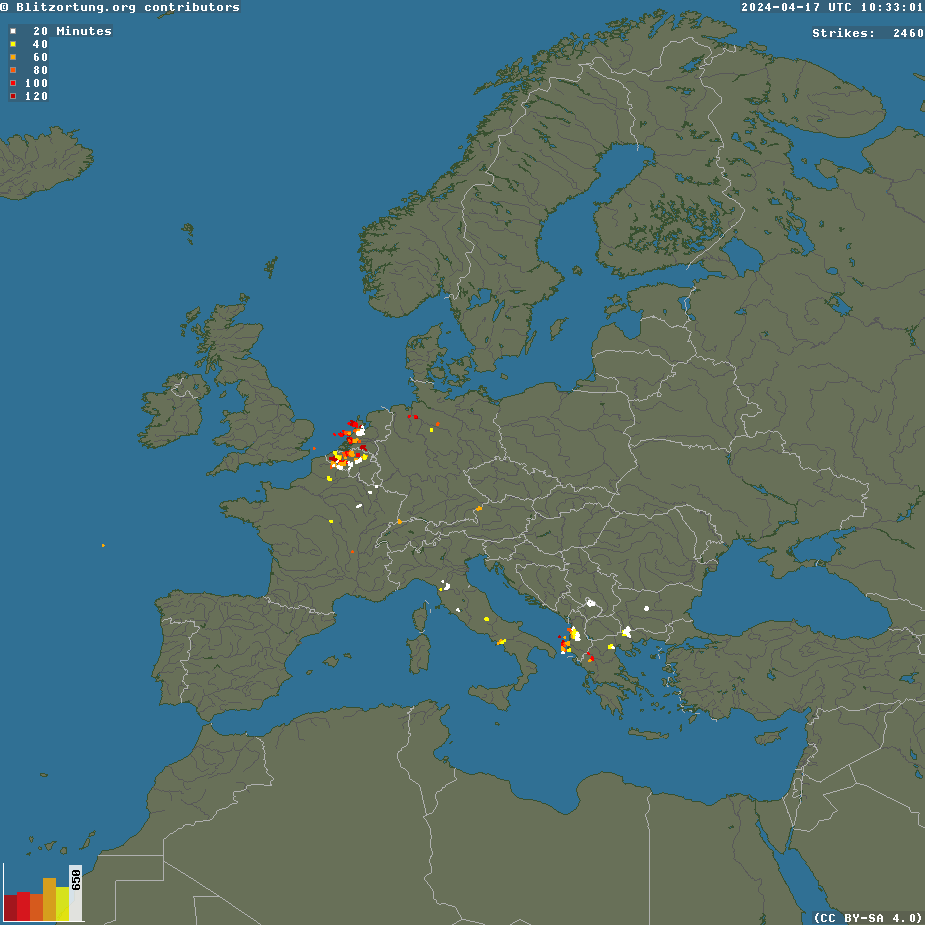 |
| Lightning map of Europe http://www.blitzortung.org/Webpages/index.php?lang=en |
Well, http://www.blitzortung.org/Webpages/index.php?lang=en gives a map showing this data.
Homebrew RF Circuit Design Ideas website
 |
| HA5KHC's useful website |
Unfortunately there is nowhere on the page with a contact address for the website owner, although I expect HA5KHC's details will be on QRZ.com.
UPDATE: Adrian YO5PBG said:
"I believe it is a mirror of the original site... of Iiulian - YO3DAC/VA3IUL - http://www.qsl.net/va3iul/Homebrew_RF_Circuit_Design_Ideas/Homebrew_RF_Circuit_Design_Ideas.htm"
New frequency for LF QRSS3 beacon : 137.766kHz
Using the strong German commercial station DCF39 on 138.830kHz (it is S9+ with me) as an accurate frequency reference, I have
checked the frequency of my QRSS3 QRP beacon and it is running higher up
the band than I thought due to the way the crystal is loaded.
Frequency to look is 137.766kHz +/- . It should be within 1Hz of this frequency.
Reports and screenshots (looking now in the right place) would be very much appreciated. I shall leave the beacon running all today at QRSS3 speed.
Frequency to look is 137.766kHz +/- . It should be within 1Hz of this frequency.
Reports and screenshots (looking now in the right place) would be very much appreciated. I shall leave the beacon running all today at QRSS3 speed.
22 Jan 2013
137kHz E-field probe mag-mount
 |
Tiny E-field probe on the car roof on mag-mount |
QRSS3 tests with QRP on 137.685kHz.
This afternoon I started my tests on the 137kHz band again. With my 8W (RF out from the unit - ERP will be uW level) crystal controlled beacon sending QRSS3 feeding the 20m spaced earth electrodes, currently under 8cm of snow, I ventured forth in the car complete with an E-field probe built into the bottom of a mag-mount antenna on the car roof. The E-field probe whip is about 12-15cm long only. It looks like a small UHF quarter wave, rather than an antenna for 2200m! The TX frequency is currently around 137.685kHz and this QRSS3 beacon will remain on overnight. I am hoping that stations out to around 100km will take a look for it.
Well, results have been spectacular with some excellent signals around 8.2km away in the line of the earth-electrodes. Orthogonally, the signal was not copyable at all at a similar range. This is classic loop directionality again.
The receiver consists of the 10-15cm long E-field probe feeding the FT817 with IPO button pressed (improves sensitivity when ON at 137kHz) feeding the PC running Spectran at 0.34Hz resolution.
I do find it unbelievable that such a TX "antenna" buried under the snow with NOTHING in the air at all and with earth rods just 20m apart can put out such a decent signal on the 2200m band.
 |
| QRP earth-electrode antenna signal at 8.2km on 137kHz band |
 |
| /M RX signal at 6km orthogonal to TX antenna. |
I do find it unbelievable that such a TX "antenna" buried under the snow with NOTHING in the air at all and with earth rods just 20m apart can put out such a decent signal on the 2200m band.
Subscribe to:
Posts (Atom)


